Monday, 30 January 2012

A traveller, not a tourist

Everyone has a dream job and I'm no different. Once upon a time, I imagined that I would like to be a travel writer. To do three things I love - writing, taking photographs and visiting other countries - and make a living out of it would be absolutely brilliant!

My Kiwi friend Peter Anderson is a travel writer and he shares the many wonderful places he has been to in his blog, Peter's Adventures. He is also a professional photographer, so you can expect to see some fantastic shots. To Peter, it's all about being "a traveller, not a tourist"; his journeys have taken him off the beaten path to the Khyber Pass, Piran in Slovenia and Lake Banani in Bangladesh, amongst others just as exotic. With much encouragement of those around him, he compiled his stories into a book Cons, Fools and Friends - 25 Years of Travelling the World, which was launched at an intimate gathering of family and friends on 29 September 2009.


In his introduction to the book, Peter tells us what travelling means to him: "... the more I travel, the more I want to photograph my feelings of the places and sights I am journeying through. Also, I want to write stories rather than articles... Now, when I travel, I tend to ponder more. I don't want to rush off to the next town; I want to become a native of the area I am visiting, even if it is only for that brief period. Travelling is for the involvement and engagement of oneself with the local ambience and nuances of life, within the culture, the cuisine and most of all, the people."

The stories he relates take us around the globe, encompassing some of the 75 countries he had visited in Europe, Asia, America, Africa and Oceania. I do wish he could have included some of his fabulous photographs (in colour, of course) but the format of the book didn't allow it.

With Cathie Muker, one of my Kiwi friends, at the launch of Peter's book.

This is not the only travel book by Peter on my shelf. So very many years ago, in 1994, he had come out with a book Discover Malaysia, written jointly with his Malaysian wife, Farida Shah. They had driven the length and breadth of this country, not just on highways and main roads, but also along tracks that took them to some interesting spots. These routes are explored in detail in their user-friendly travel guide, complete with directions to follow, sights to see, food to eat and places to stay. 

The front and back of the travel guide.


It was during that time, in the late 1990s when I had just chucked my corporate job, that the idea of travel writing came to me. A believer in being prepared, I even bought a how-to book, Travel Writing - A Guide to Research, Writing and Selling, by L Peat O' Neil. This practical book succeeded in setting me straight on a number of things. One of them is that a travel writer should carry only a sports duffel bag and a suitcase, both small enough to fit in the overhead luggage rack or under the airplane seat. "Real travel freedom," O' Neil says, "is never waiting at the baggage carousel." With such a restriction, this means packing smart, bringing only the necessities and no souvenir-buying!


The life of a travel writer may be exciting but it's certainly not glamourous. O' Neil tells the wannabe to "dash your illusions of a pampered lifestyle in luxury hotels and the first-class section... The average travel writer preparing a story for a regional travel magazine drives to a motel, tours the destination and snaps pictures, all the while asking questions and writing down information." She echoes Peter as she advises, "Fully participating in your immediate environment will open a whole new spectrum of experiences."

There are exercises at the end of every chapter. In one of these exercises, she asks to list a dozen creature comforts that the reader considers important, e.g. daily hot showers, regular meals, air-conditioning, freshly brewed coffee. "Think about how deeply you would be troubled if you had to forgo any of these habits or comforts," she warns. 

I listed, I thought and I realised that I haven't got what it takes, especially bearing in mind that I get really stressed when I take a wrong turn. Ask my husband; he's learnt never to have me along when he decides to check out a new place!

Source: msnbc.msn.com


Friday, 27 January 2012

Photo-break #9

A table setting that reminds me of days gone by. 
We had lunch at this food stall in Padang Besar, Perlis, on 30 April 2011. 


Wednesday, 25 January 2012

Cutting, soaking, stacking books... into art

I have earlier posted about what you can do with books you don't want to keep, either because you don't like them or won't be reading them again. Well, there's another thing you can do with your unwanted books - sculpt them into works of art! It's amazing what a creative mind can see in worn-out pages, turning them into intricate sculptures.

Brian Dettmer's book sculptures are works of unbelievable precision. After sealing the edges of a book, he "cuts into the surface and dissects it from the front using a range of tools that includes knives, tweezers and surgical tools" (The Guardian).


The paper-cuts by Su Blackwell are just as intricate. She "cuts out images from old books to create three-dimensional dioramas." Her work, she says, "reflect on the precariousness of the world we inhabit and the fragility of our life, dreams and ambitions."


Cara Barer, a photographer, approaches this art form differently. She soaks a book in water for several hours, after which the book takes on a new shape. She then photographs the book, creating a vivid image of pages that seem to take on a life of their own.


The works of Jacqueline Rush Lee are more deliberate, "utilising the pure components inherent in the books themselves, such as inks, covers, pages, binding threads, and reconfiguring them."


On a bigger scale, Jonathan Callan uses screws to combine books into a huge mass and, by clever positioning of covers and pages, turns them into mastepieces.


But if all these just seem too difficult to do, Paul Octavious shows that a book sculpture can be as simple as just stacking books on top of one another.


So... if you have piles of the Yellow Pages or volumes of that outdated encyclopaedia set taking up valuable space in your store-room, you know what you can do with them now. Let them bring out the artist in you.

Monday, 23 January 2012

It's that time of the year again...

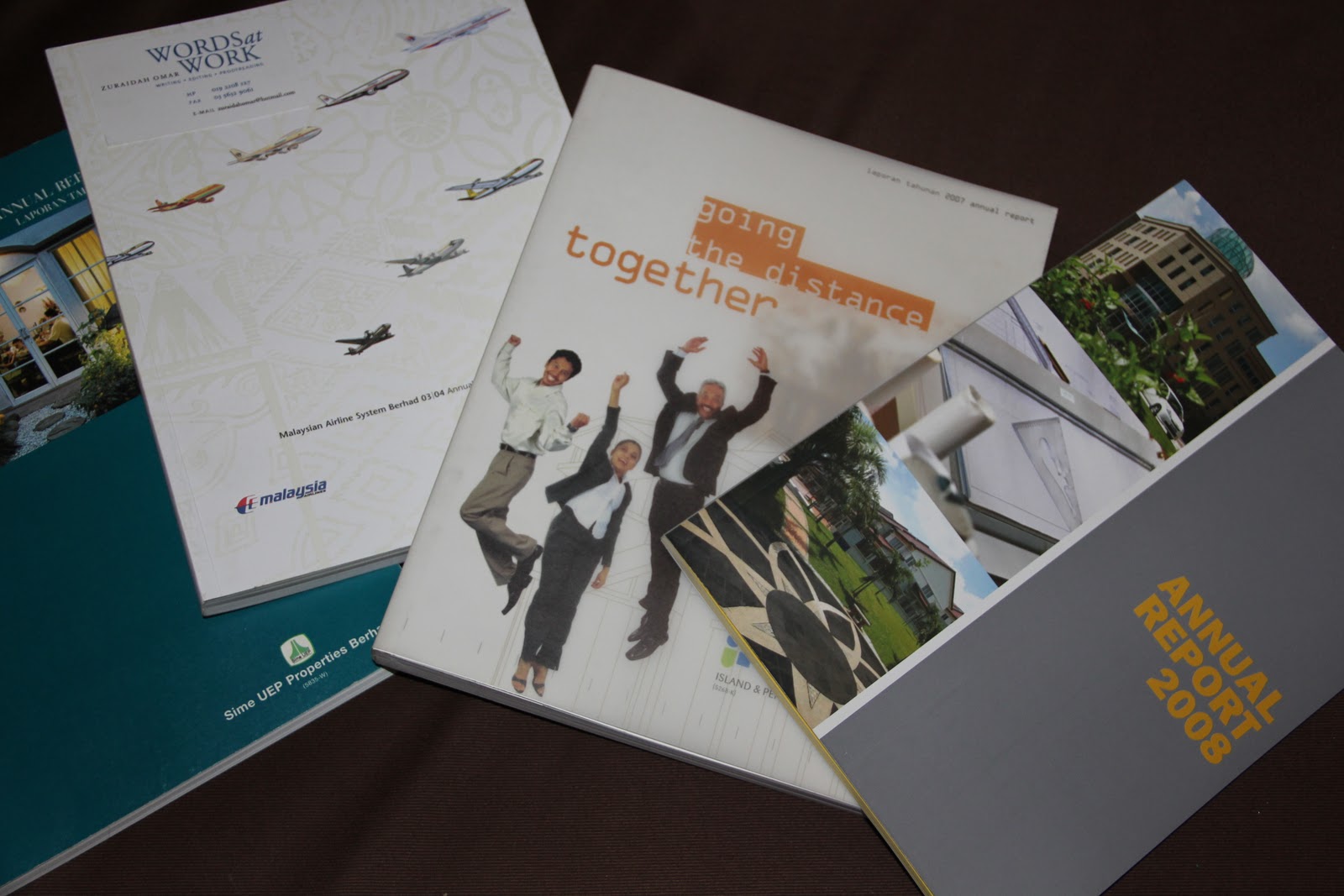
... the time when design companies are pitching to produce annual reports for the hundreds of companies listed on Bursa Malaysia, the country's stock exchange. An annual report helps shareholders understand how their investment in a particular company is doing. For those not yet invested, it gives them a good idea of the company's progress and performance, thus helping them in deciding whether or not to buy its shares.

An annual report provides information required by company law, stock exchange requirements and accounting standards. It usually begins with the chairman's statement and review by the managing director or chief executive officer. The operations review follows next, which is a detailed report on the company's performance for the financial year. The company also needs to make a statement in regard to its corporate social responsibility. There are then various sections on the company, its corporate and organisational structure, board of directors and senior management as well as corporate calendar. Before the financial statements are presented, there are the corporate governance statement, audit committee report and statement of internal control.

The annual report then is a strategic communications tool, providing the investing public with an insight into a company's vision, mission, direction and, just as importantly, its future. It is the single most important document produced by a company for the year, which is why its design and presentation are important. It must command attention and be easy to read. In Malaysia, the National Annual Corporate Report Awards have been held since 1990 to recognise corporate financial reporting.

Having been a company secretary before, I've been called on by design firms to provide writing and/or editing services for the annual reports they are producing. Sometimes, I'm approached directly by the companies. My corporate experience has certainly helped me in this area. In the first few years of my writing life, I took on way too much, doing four or five annual reports, all of which needed to be delivered within the same short time frame. It was crazy, and I had to be careful not to mix up the companies! Now I don't take on more than two a year.

Malakoff was one of my direct clients back then, and I wrote their annual report for six years. They were comfortable with me and trusted me to do the job without hand-holding. On my part, I found them easy to work with; they were professional and responsive.


Another regular client was Puncak Niaga; in this case, I provided my services to the design company that produced their annual reports.


There were other companies. One experience I wouldn't want to repeat was that of working on the annual report for Malaysia Airlines. I was the writer on a team brought together by the design firm. There were really no problems but, to finalise the design and text, we were required to work non-stop at the client's premises for 48 hours, with breaks for meals and prayers only. It was mentally and physically exhausting, and I was aching all over. When I got home, I took a nice cold shower and slept for hours.


You don't have had to work in a particular industry to be able to write the annual report of a related company. My clients included financial institutions as well as property developers and a healthcare provider. In writing an annual report, you will be relying on write-ups and other information provided by the company's business units. There will also be interviews with key people, such as the chairman and chief executive officer. Additional research on the industry is necessary because that provides the context for the company's performance. Of course, it helps if you can digest economic data and is up-to-date with what's happening in the global economy.

Writing annual reports is not for everyone and it goes without saying that, not only do you have to write well, you also have to write with confidence and conviction - because your words will be conveying what a company is all about.

Friday, 20 January 2012

Photo-break #8

Meet Chomel, the older of our two cats at home, who has been with us for over ten years. 
She was an abandoned kitten rescued by my friend, Marie Van de Panne. 
Marie couldn't keep her and brought her to Bukit Kiara Equestrian Centre, where I was asked if I would like to be her new 'mum'. Well, who could say 'no' to a face like that... 
her name was given by another one of my riding buddies, Esther Liew.
(This photo was taken by my son, Amir.)