Showing posts with label What I write. Show all posts

Monday, 16 July 2012

Ten years later...

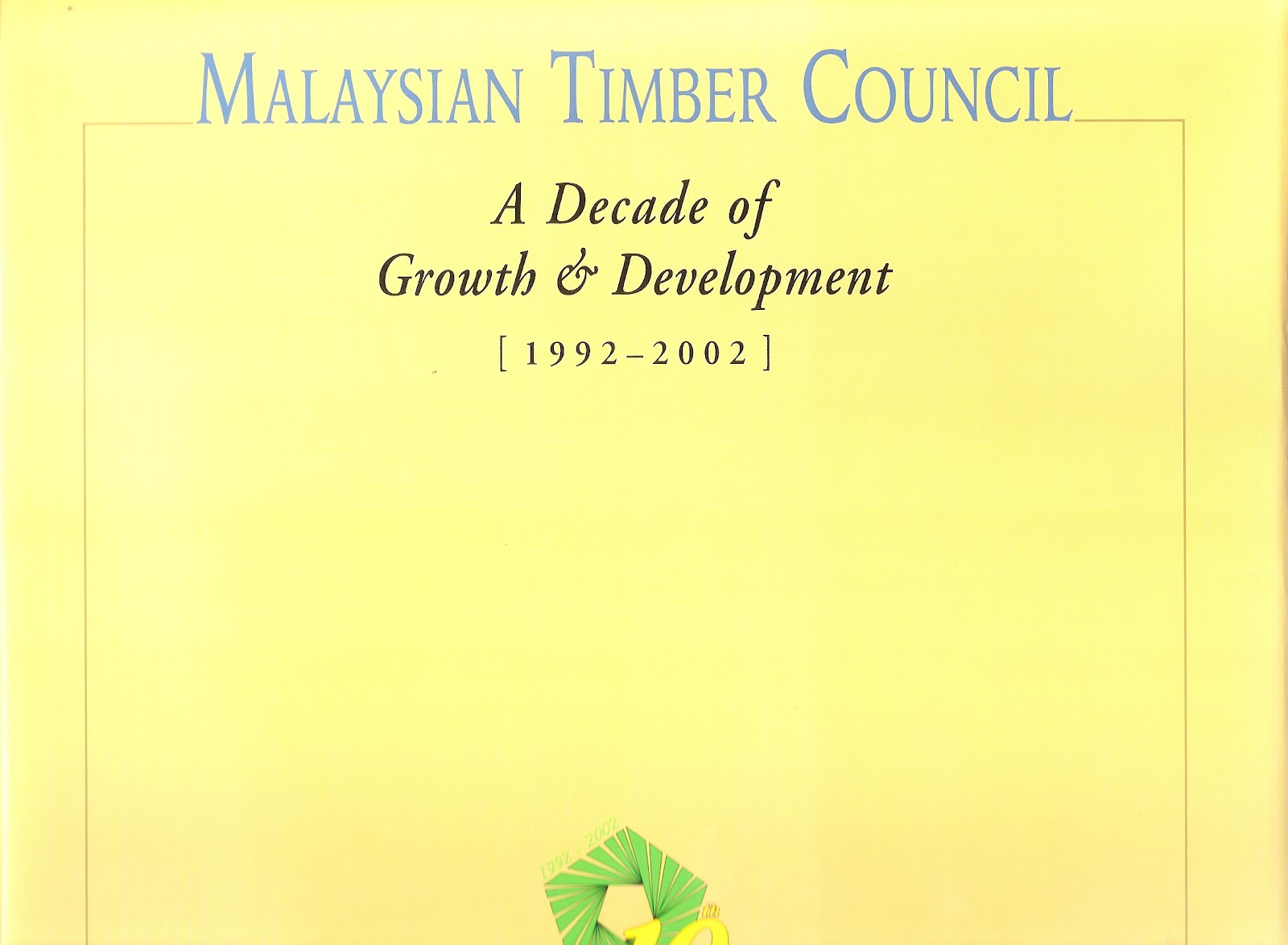
In mid-2011, I was pleasantly surprised to receive a telephone call from Suria Zainal, now Senior Director at the Malaysian Timber Council (MTC). It had been ten years since we met; I was then the writer of MTC's tenth year anniversary coffee-table book, which was produced by Editions Didier Millet. Suria told me that MTC would be celebrating their twentieth year in 2012 and they would like me to write the book. Of course, I said 'yes'! It's not often that a writer can claim to have written two commemorative books for the same organisation, ten years apart!

On 12 July 2012, MTC held a simple but classy dinner to celebrate their twenty years of serving the Malaysian timber industry, during which the book was launched. I hadn't seen the book at all before this. The text had been written by me, revised by MTC where necessary and edited by Datin Noor Azlina Yunus, with whom I had worked on my first major writing/editing project as well as my book projects for UMW Holdings. 

The design was undertaken by an advertising company and Azlina and I were not involved in the process, although we did have a look at the initial book draft. At that point, many things were not right with the book. After that, due to time constraints, Suria and her team at MTC carried on without us. It was therefore with some anxiety that Azlina and I (both of us were at the dinner) pulled the book out of its slipcase when we received our copies after the launch. Well, we were both pleased with the end result; the book we held in our hands looked nothing at all like the draft that we saw. 

The book in its slipcase.

The book... uncovered.

The start of a chapter.

Some of the pages above and below.


The book also shared the thoughts of key industry personalities.

Suria, who managed the project, had wanted the tone of the twentieth anniversary book to be somewhat informal compared to the earlier book. This was to be achieved by an anecdotal approach in the written text as well as a contemporary and bright, but not garish, design. I believe that she achieved her objective. 

The tenth anniversary book certainly looked very different 
from the newly-launched twentieth anniversary book.


Monday, 9 April 2012

About the people

In 2007, I was commissioned by top Malaysian legal firm Zaid Ibrahim & Co (ZI, now known as ZICOlaw)  to write a commemorative book to mark the firm's 20th anniversary. The book would have to convey the essence of the firm's culture and work ethic. To do this, we decided to focus on people within and who had been with the firm, its clients as well as others who had worked together with the firm.

The book Looking Back, Moving Forward is "a book of recollections and reflections, of perceptions and perspectives." The major part of my work for this book involved interviewing various people, from partners to the despatch person. It was an interesting exercise and did indeed reveal a consistency in their experiences, which highlighted that the firm did have a unique organisational culture, one that had brought it to the pinnacle of the country's legal fraternity.


The book's totally black cover with silver lettering is stark and simple, and so is the layout. Each chapter is a collection of articles on selected individuals.  At the core of it all were, of course, the two people who had been instrumental in the firm's development, i.e. founder Datuk Mohd Zaid Ibrahim and managing partner Chew Seng Kok.


Datuk Mohd Zaid Ibrahim


Chew Seng Kok


Datuk Zaid related how ZI "began as a one-lawyer show, with one secretary and one office staff member, accepting any kind of work. Then, the Malaysian government embarked on its privatisation programme and the firm got a foothold in the North-South Expressway project. ZI teamed up with a London City firm and had sufficient work to take in a few lawyers."

Chew Seng Kok told of how he chose to move "from the world's largest legal firm to one that had about nine lawyers on its payroll, preferring to leave behind a large, private, corner office with a view of Singapore's waterfront to take up one corner of ZI's open-plan office, which was by then situated in the Bank Pembangunan Building on Jalan Sultan Ismail." He did it because he bought into Zaid's vision to build up ZI into an international-class legal force.

And they succeeded. In the process, the firm attracted some brilliant people, all driven by a common purpose and governed by the same values. 


Thursday, 15 March 2012

Making sense of money

I'm no financial guru but thanks to a collaboration with one, I co-wrote a little book on financial management. This partnership is yet another example of how important it is to have integrity in your work and to do it well. My involvement with this project came about through word-of-mouth. She needed someone to help her with the book and I was recommended to her. She called, we met and clicked, and a friendship was formed.

First, about the book:


We wrote this book for the Credit Counselling and Debt Management Agency. The book, launched in 2008, is aimed at young adults to help them manage their money. The Agency felt it necessary to produce such a book because more than 50% of those seeking its help were below the age of 40. These people got into financial trouble due to their low basic financial literacy. Written in simple English, the book guides the reader in understanding the value of money, setting financial goals and budgeting. It also provides tips on building wealth, planning for uncertainties and implementing real-life financial strategies.

About my co-writer: she is Carol Yip, a certified financial coach who now travels the world giving presentations at financial conferences and running related training programmes. You could say that she's Malaysia's Suze Orman. Carol has other money management books to her credit, one of which is Money Rules. She gave me a signed copy with a very nice message.


To young people out there, it really pays to get started on your financial plan the moment you start working. Heard of the concept 'pay yourself first'? Basically, it is about saving a percentage of your weekly or monthly salary regularly, without fail, before you pay your bills or spend it on other things. And don't touch those savings! Through the power of compound interest, i.e. additional interest earned on top of the original saving amount plus the interest received, you will see your money grow. You are actually paying yourself first now for your future financial freedom. 

I wish I had such advice when I was starting out in my career. I could have really retired by now.


Thursday, 1 March 2012

Working away

Projects that come my way are of three types. The short-term ones are articles for magazines and other publications, and these take about three to five days to do, depending on the amount of research needed. I wrote a lot of these at the start of my writing life. Understandably, you can't expect to be paid much for this type of work. But if you do a lot of it, the fees can add up.

Medium-term projects would include manuals, reports as well as editorial content for annual reports. I've written quite a number of annual reports over the years. These come at a certain part of the year as companies need to complete them in time for their annual general meetings. The work is quite stressful due to the tight deadlines, more so when clients take their time to revert with their comments on the drafts. But the fees that such clients are willing to pay make up for the worry lines.

Then there are the long-term projects - coffee-table books that would usually take about six to eight months, and corporate histories that can stretch up to two years to complete. I've yet to be commissioned to write biographies. There's good money in this type of work but it requires a lot of commitment to undertake.

Whatever the project, the process is the same. In the first place, it is critical to have a dedicated workplace in the house so as not to be distracted by whatever else that may be going on with the family. And it's also important to have a trusty workmate; I got myself a new one this year - an ultralight Acer Aspire. I've learned to appreciate the need for such a notebook after lugging my previous one about to meetings and interviews.

My new workmate in my home office.

And yes, there will be meetings to fine-tune what the client wants. For a book, the project brief forms the basis to conceptualise its structure and contents, and guide the research needed. The latter will cover document research, i.e. whatever publications, reports, newsletters and materials pertaining to the client's organisation; internet research on the industry and global as well as national economy for the period in question; and interviews of people who can provide stories and inside information. For the books that I wrote for UMW and Commerce Asset, I had to also delve into the country's history.

It pays to be organised at the research stage of a project. Otherwise, the writing will be a nightmare. I would already have the book's outline at the outset, so it would be a matter of putting the data that I've gathered in the right 'compartments'. The reading process needs to be systematic as well, marking parts that would be useful for the book.

Post-it notes on these annual reports and newsletters help me find the information I need.

After the research is completed, which may take a few months, the writing begins. The first line is always the most difficult because it will set the tone and style for the rest of the book. In fact, I would take days just to get the first paragraph right. But once that's done, the rest of the writing will flow easily (this is only if I had been meticulous in organising my research notes). Because there will be moments when I would be stumped for just the right word, I have a lot of reference books to get me through. Not just on language, but also on history, economics and other areas.

My language helpers; my books on history, society, economics and finance are on other shelves.

For a book, the writing process for the first draft takes about four months. I do a great deal of self-editing, at least a couple of rounds, during which I would go over my draft, changing words, tightening paragraphs and rearranging content. Once completed, of course to a given deadline, the first draft would be submitted to the client for review, after which the draft will be revised to cover any meaningful feedback. The final draft is then approved; my part is over and an editor then will peruse the draft for overall consistency and correctness. Thereafter, the book proceeds to the design, layout and production stage.

Writing a book can be a drain on the brain; it's actually rather mentally tiring. Which is why when I'm writing, I'm also drinking a lot of this...

Can't keep going without a cup of hot coffee!


Monday, 6 February 2012

It began as a spare parts shop...

One day in the later part of 2005, I received an e-mail from an ex-client asking if he could give my contact number to the chief of a Malaysian multinational corporation. Of course, I said 'yes' and soon after, I was in the office of Dato' Abdul Halim Harun, Group Managing Director and Chief Executive Officer of UMW Holdings Berhad. And he told me a little story.

Dato' Halim had been given a copy of the corporate history that I wrote for the Commerce Asset Group, Of People And Principles, and he wanted to commission such a book for UMW. But he had no idea how to get in touch with me. One evening, he was at a wedding reception and seated beside him was a gentleman. As they spoke and got to know one another, he found out that the gentleman was from Commerce Asset and had been involved in the book project. That was when he asked for my contact number and that was how I got to write Turning Points - The UMW Story, which was published in 2008.


A big project like this had to be top-driven. Dato' Halim championed it but, being a busy man, he placed it in the hands of Suseela Menon, UMW's Company Secretary and Executive Director of UMW Corporation Sdn Bhd. Together, they monitored the book's progress while I worked directly with Farida Mohd Salleh and Zalina Zainal Abidin of the Group's Public Affairs Division as well as Yap Teck Ming, a longtime employee who knew the organisation's history and people who had been working there from the early days. They helped me with the research and set up interviews with numerous individuals. 

The book traces the company's growth from an entrepreneurial family business to a public listed company, which then developed into one of the country's most successful conglomerates. Of course, companies don't exist in a vacuum so I set the book within the context of Malaysia's historical and economic development. The UMW story is an amazing one that began in 1917 when Chia Yee Soh, the Group's founder, set up a small automotive spare parts shop named United Motor Works. It was a dream come true for someone who had toiled away since he was 14 years old, initially as an apprentice in 1902 and then foreman, in a bicycle shop in Singapore. Thanks to his business acumen and hard work, the company spread its wings into then Malaya; while one son took charge of the Penang office, another, Eric Chia (later to be accorded the titles of Datuk and Tan Sri), went to work in Kuala Lumpur. 

The story of UMW in Malaya/Malaysia from the late 1950s to the 1980s is synonymous with the story of Eric Chia. He was a larger-than-life character who, due to his physical size and intimidating personality, struck fear as well as respect in those around him. UMW became a big player in heavy equipment as well as motor vehicles during his time and it was also on his watch that the company was listed on the stock exchange. Eric Chia was aggressive in business, which proved to be his undoing when the boom years turned to gloom in the mid-1980s. UMW was mired in debt and would have become insolvent if one of its main shareholders, Permodalan Nasional Berhad (PNB), had not come to the rescue. Of course, this meant loss of control by Chia of the Group he had built up over the decades. 

With PNB in the driving seat, UMW moved to the next stage of its development, that of a corporation that grew to become what it is today - a Malaysian multinational with interests in automative; equipment; manufacturing and engineering; and oil and gas, which are spread across more than 90 companies in 13 countries. Truly a Malaysian success story. 

Tan Sri Datuk Eric Chia passed away in 2008 and UMW's top management dedicated the book to him. I would have liked to interview him for the publication but various things stood in the way. 

In his foreword to the book, Dato' Halim declares the reason for initiating the book: "It is essential that (UMW's) history be recorded so that the thousands of people employed by the UMW Group, now and in the future, will know how UMW developed into a corporate organisation with a distinct culture..." Chairman Tan Sri Datuk Asmat Kamaludin, in his message, sees the book as adding "to the store of knowledge that currently exists on Malaysian corporations."

It was in the spirit of lifelong learning that the UMW Management Series was subsequently conceptualised; a series of books "- some illustrating 'successes', others illustrating 'misses' - with the hope that in sharing our experiences, we are helping those within our organisations as well as people beyond our boundaries to better appreciate the trials and tribulations of doing business in an ever-changing world." Those are the words of Dato' Halim in his foreword to the first book in the series, UMW-Dennis Specialist Vehicles Sdn Bhd - A Bumpy Ride, which was launched on 29 September 2010, a day before he retired from UMW.


Writing the book for UMW, as well as the one for Commerce Asset, showed me what it was like working with people who are truly professional. Not only that, in both instances, the employees tasked with the project were committed and ensured that I had whatever materials were available. Interviewees were helpful with information and forthcoming in their responses. And as the project progressed, top management often checked to see whether I got what I needed. 

On a personal level, such books are dream projects because they have allowed me to contribute to the knowledge that we have on the people and organisations that make up our Malaysian society.

Monday, 23 January 2012

It's that time of the year again...

... the time when design companies are pitching to produce annual reports for the hundreds of companies listed on Bursa Malaysia, the country's stock exchange. An annual report helps shareholders understand how their investment in a particular company is doing. For those not yet invested, it gives them a good idea of the company's progress and performance, thus helping them in deciding whether or not to buy its shares.

An annual report provides information required by company law, stock exchange requirements and accounting standards. It usually begins with the chairman's statement and review by the managing director or chief executive officer. The operations review follows next, which is a detailed report on the company's performance for the financial year. The company also needs to make a statement in regard to its corporate social responsibility. There are then various sections on the company, its corporate and organisational structure, board of directors and senior management as well as corporate calendar. Before the financial statements are presented, there are the corporate governance statement, audit committee report and statement of internal control.

The annual report then is a strategic communications tool, providing the investing public with an insight into a company's vision, mission, direction and, just as importantly, its future. It is the single most important document produced by a company for the year, which is why its design and presentation are important. It must command attention and be easy to read. In Malaysia, the National Annual Corporate Report Awards have been held since 1990 to recognise corporate financial reporting.

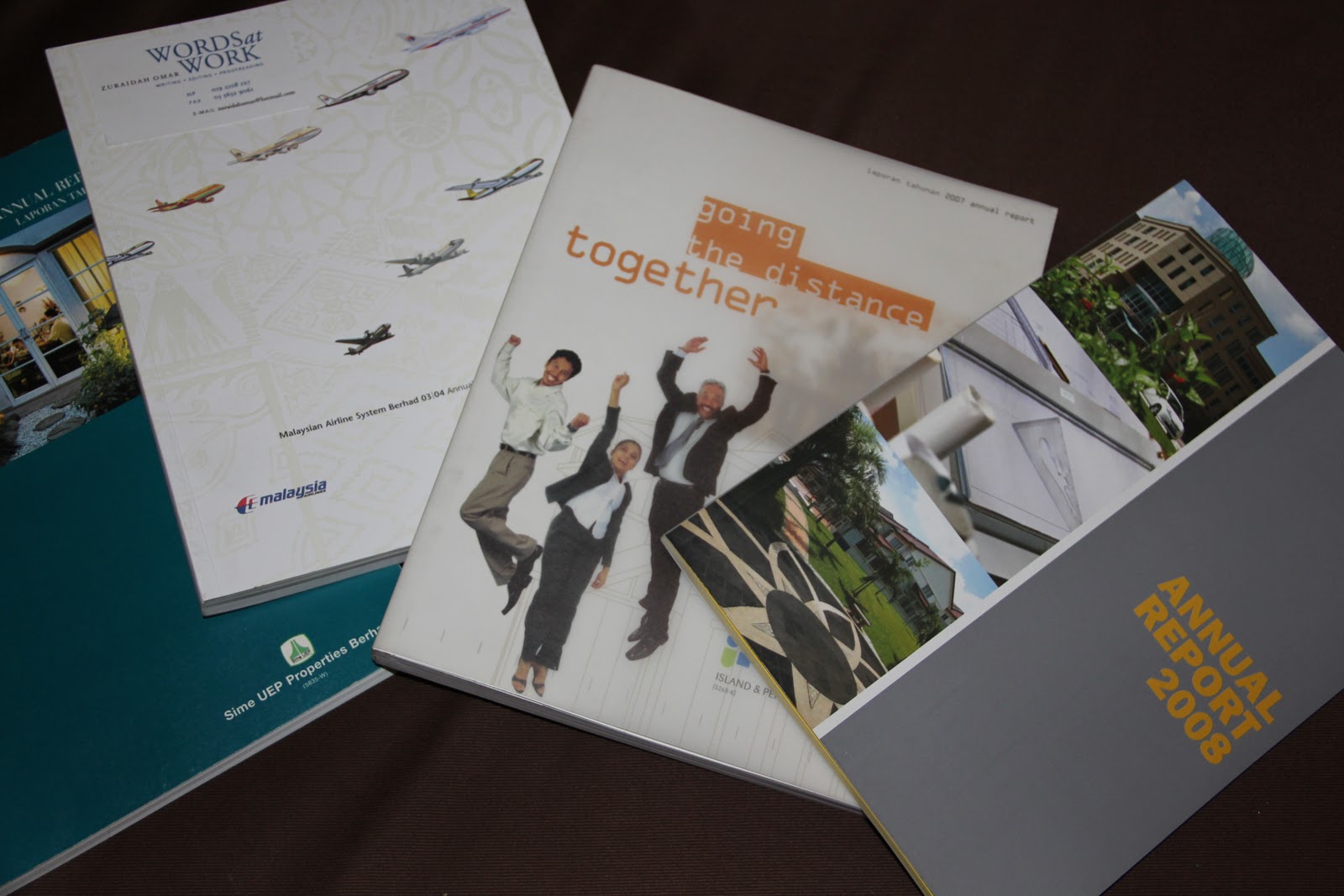
Having been a company secretary before, I've been called on by design firms to provide writing and/or editing services for the annual reports they are producing. Sometimes, I'm approached directly by the companies. My corporate experience has certainly helped me in this area. In the first few years of my writing life, I took on way too much, doing four or five annual reports, all of which needed to be delivered within the same short time frame. It was crazy, and I had to be careful not to mix up the companies! Now I don't take on more than two a year.

Malakoff was one of my direct clients back then, and I wrote their annual report for six years. They were comfortable with me and trusted me to do the job without hand-holding. On my part, I found them easy to work with; they were professional and responsive.


Another regular client was Puncak Niaga; in this case, I provided my services to the design company that produced their annual reports.


There were other companies. One experience I wouldn't want to repeat was that of working on the annual report for Malaysia Airlines. I was the writer on a team brought together by the design firm. There were really no problems but, to finalise the design and text, we were required to work non-stop at the client's premises for 48 hours, with breaks for meals and prayers only. It was mentally and physically exhausting, and I was aching all over. When I got home, I took a nice cold shower and slept for hours.


You don't have had to work in a particular industry to be able to write the annual report of a related company. My clients included financial institutions as well as property developers and a healthcare provider. In writing an annual report, you will be relying on write-ups and other information provided by the company's business units. There will also be interviews with key people, such as the chairman and chief executive officer. Additional research on the industry is necessary because that provides the context for the company's performance. Of course, it helps if you can digest economic data and is up-to-date with what's happening in the global economy.

Writing annual reports is not for everyone and it goes without saying that, not only do you have to write well, you also have to write with confidence and conviction - because your words will be conveying what a company is all about.

Monday, 26 December 2011

A gem of a book

What makes a good book project? First on the list would be that the project is top-driven by a client with a clear brief and open to new ideas. Often, clients want a book but are clueless about what sort of book they want, such that the project becomes a time-wasting process of elimination - okay, he doesn't want that; no, that one isn't working for him either; afraid that isn't quite it.

Next on the list would be a small team comprising top management members (three is a good number) that is empowered to make decisions on the book, a team that doesn't have to refer to the chairman or the council at every turn. And third, which is important to get the project moving along, is a liaison or link person, someone within the organisation, who is committed and excited about the project. This person has to know what materials are required and who to talk to, and be able to sort out meetings and interviews.

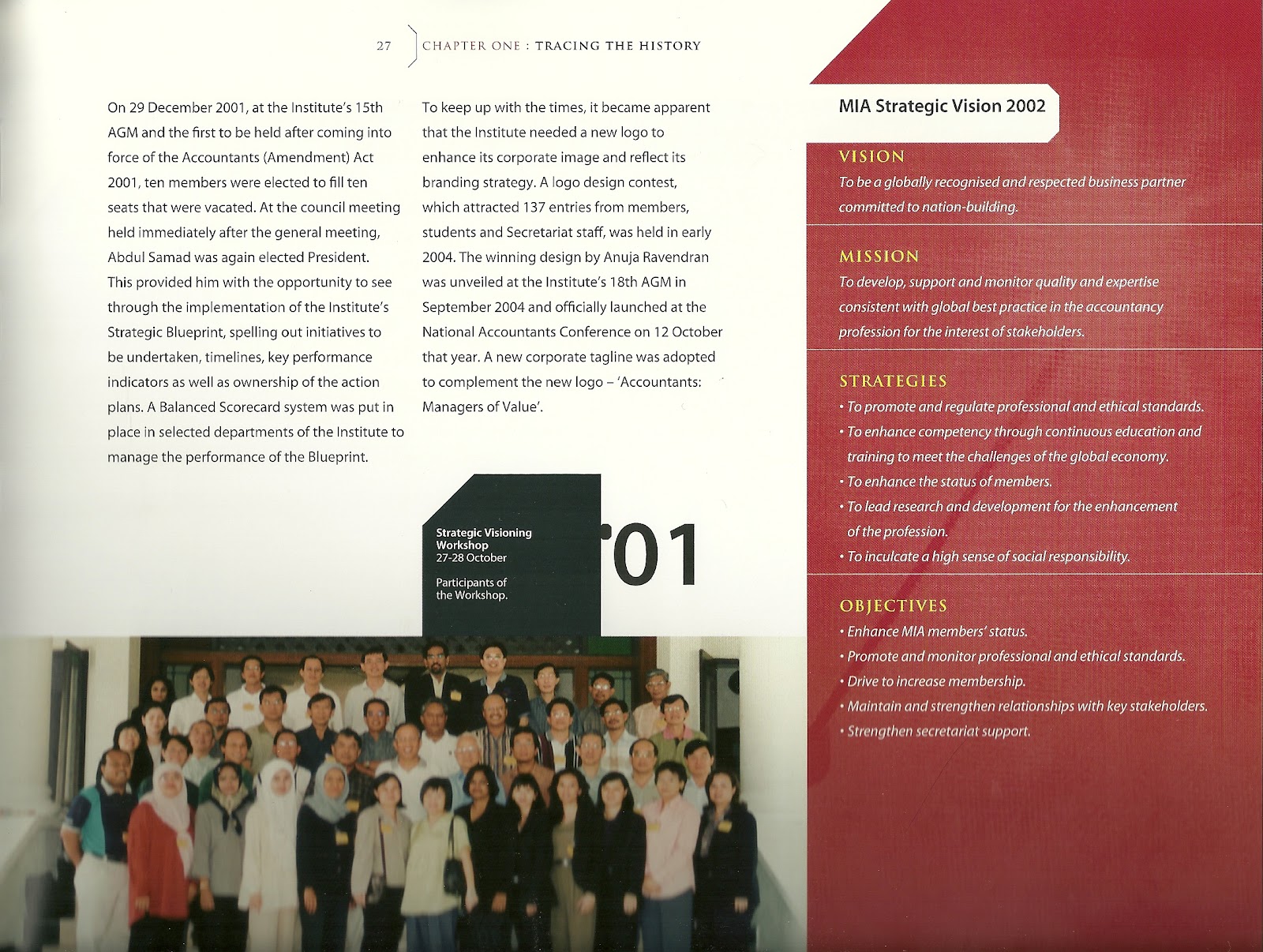
My brother Zaid Omar of Milk Design and I were fortunate to have the above when we worked on the tenth anniversary coffee-table book for the Federation of Malaysian Unit Trust Managers. We enjoyed the same experience with the book commissioned by the Malaysian Institute of Accountants (MIA) to commemorate its 40th anniversary. The team responsible for the book couldn't have been more top-driven - the members were MIA's president and vice-president at that time, Abdul Rahim Abdul Hamid and Nik Mohd Hasyudeen Yusoff respectively, and council member Dato' Khalid Ahmad. And the person pushing the project along was head of communications Iszudin Mohd Amin.

What they didn't want was a boring blue book. They wanted a fresh contemporary design and liked the concept of employing art in the book. When we suggested caricatures of key people to accompany quotations, they were all for the idea. The book utilised the ruby, the gemstone denoting a 40th anniversary, as its main design element. The red of the ruby was perfect to signify "a vibrant profession that plays a vital role in Malaysia's economy" and its facets were carried through as a feature within the book's pages.


The book cover of Malaysian Institute of Accountants: 
National Aspirations, Global Ambitions 1967-2007


The sharp facets of the ruby are reflected in the side-bar and captions on the page above 
and the illustrations below.


Some of the people interviewed are depicted in caricatures to accompany their call-out quotations.


Five original art-pieces set the stage for each chapter in vivid colours and flamboyant figures.

Tracing the History

Strengthening the Profession

Educating Accountants

Promoting the Institute

Going Forward


Zaid and I found the MIA book project team brilliant to work with because its members trusted us to deliver what we do best, i.e. to design and write. They didn't impose their personal styles on us and, thanks to their international exposure, they appreciated contemporary design. For example, on seeing an opening page as follows, some clients would balk and say, "What? So much space wasted!"


To their credit, the MIA team members knew what white space and balance on a page were all about. Working closely together with them, we succeeded in producing a gem of a book.

Monday, 12 December 2011

Last-minute call

It was 2001; I had been writing freelance for just about two years and was eager to build up my work portfolio. Therefore, when my friend Tan Kwang How, a management consultant whom I got to know quite well when I was working full-time, called me with a project offer, I was ready to listen.

"The situation is like this," he explained. "The publisher McGraw-Hill had asked Maimunah Aminuddin and I to produce a four-book set on human resource management. Maimunah wrote one of the books, I did two and someone else did the fourth book on managing performance. Unfortunately, this fourth book is not up-to-mark and I'd like to ask you to write a new one from scratch."

I was attracted to the offer. I had heard of Maimunah, a human resources specialist who had written several books on human resource management and industrial relations, and liked the idea of being part of this joint initiative. "But," Tan went on, "you need to have the final draft ready within a month and it has to be about 100 pages long." I said okay, even though I would be paid royalty based on sales, something which I'm not keen on because the total amount I would receive would be very small, given book sales in this country.

I accepted the job because of the opportunity to work with Maimunah, who functioned as editor of the series, and Tan. Also, McGraw-Hill is a reputable international publisher and being a co-writer of one of their book sets would look good on my portfolio. I completed the final draft in time and the end result is Managing Performance in Malaysian Organisations, one of four books that make up The HRM Toolkit for Malaysian Practitioners. The other three books in the set are Recruitment and Selection in Malaysian Organisations (by Tan), Compensation Management in Malaysian Organisations (also by Tan) and Effective Training in Malaysian Organisations (by Maimunah).


It was quite an experience to receive a cheque every now and then over a number of years. The lengthy time in-between cheques meant that I'd forget about the royalty payment and would be pleasantly surprised to receive one in the post, regardless of the amount.

Wednesday, 30 November 2011

Art in a book

My brother Zaid designs and I write. It was a just a matter of time that one day, we would work on the same project. That time came in 2003 when Kathy Tan, who was then Executive Director of the Federation of Malaysian Unit Trust Managers (FMUTM), now known as the Federation of Investment Managers Malaysia, called me up to talk about producing a coffee-table book to commemorate FMUTM's tenth anniversary. The brief was to design, write and produce the book to a specific theme.

Noting that the unit trust industry was still growing, Zaid and I came up with a theme based on nature. FMUTM liked our proposal to trace its development through art by commissioning six original art-pieces as the creative base to illustrate the concept of growth and potential. These art-pieces served as the book cover and chapter division pages, and during the tenth anniversary gala dinner, they were framed and presented as gifts to VIP guests.

As explained in the book, "the cover art-piece, portraying the abundance and vitality one finds in nature, is reflective of the opportunities available in the unit trust industry. Motifs depicting various stages of growth in plant-life are brought together to illustrate the development cycle. The imaginative use of colours and patterns convey a sense of energy and innovation, elements that are essential for the further development of the industry." The chapter titles carried on with the theme - Chapter 1: Planting the Seed; Chapter 2: Growing the Industry; Chapter 3: Nurturing with Care; Chapter 4: Reaching Beyond; and Chapter 5: Developing Organically.

The book cover

The story of FMUTM's beginnings is conveyed through the juxtaposition of panels of seeds.

The idea of growth is reflected in the dominant use of plant roots in this art-piece.

The arrangement of images and patterns intimate at FMUTM's relative youth.

Flowers and leaves depict the blossoming of FMUTM regionally and internationally.

In the final art-piece, trees are arrayed in a line to depict the counting of FMUTM's achievements. The colour blue comes vividly in the picture to indicate the commitment required to bring the Federation beyond the horizon.

As in the corporate history book project of the Commerce Asset Group, working on FMUTM's tenth anniversary coffee-table book was a pleasure. Zaid and I worked with a small team headed by Kathy Tan, touching base occasionally with then President of FMUTM, Dato' Seri Abdul Azim Mohd Zabidi. Approvals were quick and the team was receptive to our ideas. Zaid and I, and more importantly FMUTM, were happy with the end result (by the way, the colours of the pages above are more vibrant in the actual book). One thing about the book that could have been better was the quality of the archival photos, which were not taken by professional photographers but understandably by staff members present at the various events. 

Monday, 21 November 2011

The story of a bank

I received a call from Joe Fernandez late this afternoon. I haven't seen him for ages and he called because he would like to buy a copy of Hajj - The Humbling Journey. God willing, we'll meet up next week. Who, you might ask, is Joe Fernandez? Well, without him, I wouldn't have written Of People and Principles - The Commerce Asset Story.


In the book, published in 2003, I acknowledged Joe as "my partner in this endeavour,... a conscientious researcher and effective project coordinator." Joe, who had worked at Commerce Asset and knew it intimately, was asked by its management to spearhead the publication of the Group's corporate history. He needed a writer and, through people he knew, principally Dato' Seri Abdul Azim Mohd Zabidi, he found me.

The book took about two years to see the light of day, during which time Joe and I worked closely together in conceptualising the book, interviewing key people, going over archival documents and photographs, revising and redrafting chapters. I truly enjoyed working on the book - the management was committed to it and went out of its way to ensure that resources and people were made available to us. But the best part of it was that a small team of three top management staff was assigned to approve various aspects of the project as we went along. There was no red tape, it was smooth going, and I could write the story as I saw it.

It was fantastic the way everyone whom I interviewed opened up, providing me with never-before-heard anecdotes, sharing private conversations, and giving behind-the-scene insights into how decisions were made in the boardroom and executive office. 

The result is a story that began with Bian Chiang Bank, a one-branch, family-owned bank in Kuching, Sarawak, which metamorphosed in 1978 into Bank of Commerce after its purchase by the Fleet Group. The book then traced the Bank's growth through the economic recession of the 1980s, the Asian financial crisis of the late-1990s and its merger with United Asian Bank in 1991 and then Bank Bumiputra Malaysia in 1999, to become Bumiputra-Commerce Bank. There is also a chapter on how Commerce Asset was able to fend off being a takeover target in 1998. A parallel story in the book is that of Commerce International Merchant Bankers (CIMB).

The Commerce Asset Group and Bumiputra-Commerce Bank are now no more. In their place is the CIMB Group, a regional universal bank. How that has come about would make another riveting story. 

Friday, 18 November 2011

Going with Graduan

Elia Talib is a woman to be admired. In 1995, she launched an annual publication called Aspirasi Graduan, now known as Graduan, aimed at helping fresh graduates prepare for the job market. She has remained focused on her target audience but has extended her product and brand into other related publications, a job website, web TV, as well as career fairs in Malaysia, Australia, England and the US. She has succeeded in doing this almost single-handed, with the help of a small staff and now her two recently-graduated children.


I was introduced to Elia by Ann Lee, whom I've written about in an earlier post. Ann was Graduan's consultant editor and she and Elia wanted to bring more writers on board. So it was that I became a regular contributor, and at times editor, of the publication. I also edited Xtracurriculah!, an activity resource guide for school-children, for two years and a recent Graduan offshoot, Careers in the Capital Market.


Over the past few years, due to my other writing commitments, my involvement with Graduan has lessened, limited to one or two Special Feature articles per issue of leaders in the corporate or political world as well as academia. Elia needs a senior writer for these articles because it's not easy sometimes to get such such people to talk freely; my corporate experience has helped me in this respect. 

Perhaps the most daunting person I've had to interview for Graduan was Tun Dr Mahathir Mohamad. Although I was accompanied by Elia and Ann to his imposing office at the Perdana Leadership Foundation building in Putrajaya, it didn't help to settle the butterflies in my tummy. I had heard that he doesn't suffer fools gladly and could send you out of the door before you could start. His personal assistant told us that we had 15 minutes to do the interview but I must have been asking him the right questions and making the appropriate remarks in return to his answers, because we stayed for more than an hour. He even agreed to be photographed with us and signed my copy of The Malay Dilemma that I had brought with me (Elia and Ann felt like kicking themselves for not bringing theirs).


There's a trick to meeting and interviewing personalities like Tun Mahathir. Of course, in the first place, you need to be well prepared - long pauses and 'aahs' won't impress such people. You need to be on your toes and respond appropriately, because they might not give the answers you expected. The main thing, however, is to remember that we are all creations of Allah and that we'll all stand equally before Him on the Day of Judgement.

Saturday, 12 November 2011

A personal project

It was November 2010 and my husband and I were in Makkah to perform our Hajj. It was by Allah's Will that my good friend Yasmin Gan Abdullah and her husband were there as well. Two weeks before I was to leave Malaysia, she had called me with her good news and we were both delighted to learn that we would be in the Holy City at the same time. We promised, God willing, to meet up in Makkah.


We did and Yasmin mooted the idea of sharing our personal Hajj journey through words and images in a coffee-table book when we return home. Hajj is a very intense experience and we were of one mind that we would like to express this, not only to encourage those who hadn't yet been to go but also to help relive memories in those who had. We wanted the images to be original so took photographs whenever we had the opportunity. I didn't bring a camera so used my Nokia N86 which has an 8mp camera - the photographs, such as the one above, came out thankfully well.

Although we were back home in December, we didn't get down to writing immediately because of other work commitments. Yasmin then set the deadline for us to get started on our book - the very first personal project for us. We agreed that the book would have two parts, one comprising three chapters - an introduction to the Hajj, my journey and Yasmin's - and the other consisting of photographs that we had taken of the Hajj, the people of Islam, Masjid Al-Haram in Makkah and the Prophet's Masjid in Madinah. Because of our respective strengths, Yasmin would handle the design and production aspects while I would write whatever else required. 

Initially, we worked on the premise of getting sponsors to underwrite the production costs of the book but this proved to be an exercise in futility. We still wanted to publish the book, however. Alhamdulillah, Yasmin succeeded in working out an arrangement with the printer to pay in instalments as the book is sold. It was exciting to see the book coming together over a period of months and we were soon at the stage of checking proofs.


To generate interest in the book, we started a Facebook page and geared ourselves towards 'launching' our book, Hajj - the Humbling Journey, on 8 October. Just three days before, 500 copies of the book were delivered to my house, the other 500 to Yasmin's office.


Earlier, we had to deal with the question of how to launch the book. Given our very limited budget, we decided to introduce the book to a small group of abut 40-50 people over brunch at my house. Our immediate family members and close friends were asked to come, and we also invited those who had liked our Facebook page.

Next question - who to introduce the book? We sought the advice of my dad's cousin, Datin Kalsom Taib (or Auntie Chom, herself the author of three books, one of which is on her husband). Unfortunately, the person she suggested wouldn't be available. The day before the event, over breakfast at my house to finalise details, it dawned on Yasmin and I that the most appropriate person would be Auntie Chom, who had been very supportive of our initiative. I called her and she immediately said yes.

And thus on 8 October, our book was finally introduced. 

Yasmin, Auntie Chom and I

The book cover

Yasmin and I with designer Junaida and project assistant Norhayati

Now comes the hard part - selling the book. Yasmin and I were not in favour of distributing our book through the usual bookshops, as the commission charged would mean that we wouldn't be able to meet our production costs. The best way would be to sell the book ourselves and place it at selected places, including Sri Munawwarah and Dakwah Corner Bookstore. Alhamdulillah, the response to our book has been heartwarming and encouraging. We feel truly blessed to have realised our niat (intention) of sharing our humbling Hajj journey.